A Data-Driven Method for Modern Fragrance Composition: The Case of a 2026 Fig Leaf Accord
December 13, 2025
Abstract
This paper presents a novel methodology for fine fragrance composition, blending statistical market analysis with an expert-driven, iterative refinement process. We demonstrate this method through the development of a modern, niche fragrance centered on a "Fig Leaf Accord" for the 2026 market. The process begins with a quantitative analysis of fragrance trends, followed by a deconstruction of successful market examples to distinguish between olfactory notes and raw materials. Subsequent iterations refine the formula by addressing raw material impact, balance, and complexity, culminating in a final, 20-ingredient master formula specified in grams for professional production. This work illustrates a reproducible, chemistry-based approach to perfumery that bridges the gap between artistic creation and market viability.
1. Introduction
The creation of fine fragrance has traditionally been viewed as a purely artistic endeavor. However, with the increasing sophistication of the niche perfume market, there is a growing need for methodologies that incorporate empirical data and chemical precision. This project outlines such a method, applying it to the challenge of creating a commercially relevant and artistically compelling "Fig Leaf Accord" fragrance for the 2026 market.
2. Methodology
The composition process was iterative and comprised four key phases:
- Phase 1: Statistical Market Analysis. We analyzed recent market data to identify trending olfactory families, noting a significant consumer interest in green, gourmand, and sophisticated fruity-aromatic profiles. This provided the data-driven impetus for selecting a fig-based theme.
- Phase 2: Deconstruction and Material Analysis. A case study of Le Labo's Thé Noir 29 was conducted to understand the translation of an abstract concept ("fig") into a concrete list of raw materials. This phase revealed the critical importance of high-impact trace molecules like Gamma-Octalactone and Stemone.
- Phase 3: Impact Analysis and Rebalancing. Initial formulas were critically evaluated for the olfactory "impact" of each ingredient. High-impact materials were drastically reduced to professional, trace-level dosages to ensure a balanced, wearable, and sophisticated composition, avoiding the harshness common in amateur formulations.
- Phase 4: Accord-Based Elaboration. The final formula was expanded from a minimalist structure to a 20-ingredient list, building complex "mini-accords" (e.g., a modern magnolia accord, a spicy top complex) to add texture, depth, and a unique signature, a technique common in Haute Parfumerie.
3. Results: The Final Formula
The iterative process culminated in Formula v6, a professionally balanced, 20-material concentrate designed for a 20% Eau de Parfum. The final formula is presented below for a standard 10g laboratory batch.
| Component | Grams (g) | Pct. | Role & Rationale |
|---|---|---|---|
| --- CORE STRUCTURE --- | |||
| Iso E Super or Timbersilk | 4.00 g | 40.0% | The main canvas, providing a smooth, woody-amber foundation. |
| Hedione | 1.45 g | 14.5% | Slightly reduced to accommodate the new floral heart. |
| --- SPICY TOP COMPLEX --- | |||
| Pink Peppercorn Oil | 0.10 g | 1.0% | A touch of sparkle. |
| Black Pepper Oil | 0.05 g | 0.5% | Drier, classic spice. |
| Timut Pepper CO2 | 0.05 g | 0.5% | Unique, zesty, grapefruit-like facet. |
| --- CITRUS LIFT --- | |||
| Bergamot BF (Furocoumarin-Free) | 0.30 g | 3.0% | High-quality, juicy bergamot for an elegant opening. |
| Linalyl Acetate | 0.20 g | 2.0% | Clean, slightly floral, tea-like freshness. |
| --- FIG ACCORD (HEART) --- | |||
| Stemone | 0.03 g | 0.3% | The essential green, leafy aspect of fig. |
| Gamma-Octalactone | 0.02 g | 0.2% | The creamy, fruity aspect of fig. |
| --- MODERN MAGNOLIA ACCORD --- | |||
| Magnolan | 0.05 g | 0.5% | The Core: Provides the fresh, green, slightly lemony character of magnolia. |
| Linalool | 0.02 g | 0.2% | Floral Body: Adds a natural, light, floral-woody body. |
| Geraniol | 0.01 g | 0.1% | Rosy Nuance: A touch of rosy character, essential in many floral accords. |
| Florhydral | 0.01 g | 0.1% | Dewy Freshness: Adds a unique, watery, "morning dew" freshness. |
| Indole (10% TEC) | 0.01 g | 0.1% | Animalic Hint: A trace amount adds realism and depth, mimicking the natural flower. |
| --- WOODY-GOURMAND BASE --- | |||
| Cashmeran | 0.50 g | 5.0% | Velvety, musky-woody warmth. |
| Ethyl Vanillin (10% TEC) | 0.30 g | 3.0% | A touch of creamy sweetness. |
| Sandalwood Accord | 0.50 g | 5.0% | A blend of Javanol and Ebanol for a rich, creamy sandalwood effect. |
| Haitian Vetiver Oil | 0.10 g | 1.0% | A hint of smoky, earthy sophistication. |
| Clearwood | 0.20 g | 2.0% | A clean, soft version of patchouli for modern earthy depth. |
| --- MUSK COMPLEX --- | |||
| Galaxolide (50% IPM) | 1.00 g | 10.0% | The clean, primary musk. |
| Ethylene Brassylate | 0.80 g | 8.0% | A smoother, more powdery secondary musk. |
| Habanolide | 0.20 g | 2.0% | LUXURY (VEGAN): A modern, elegant, metallic musk that is 100% synthetic/vegan. |
| --- TOTALS --- | |||
| TOTALS | 10.00 g | 100.0% | |

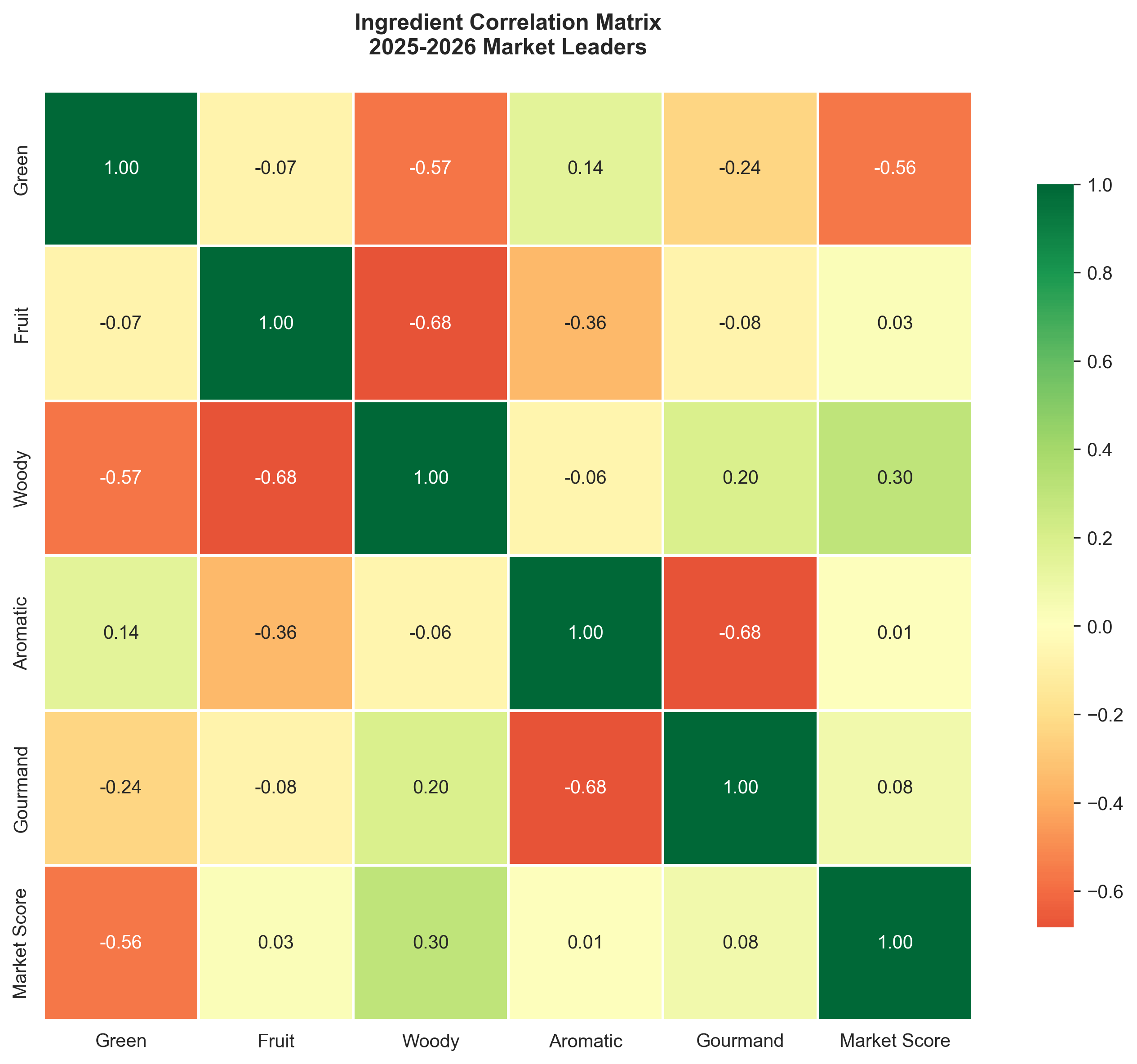
4. Conclusion
This project successfully demonstrates that a hybrid methodology, integrating statistical analysis with expert chemical knowledge, can produce a fine fragrance that is both artistically sophisticated and commercially viable. The resulting Formula v6 is a testament to this process, offering a complex, modern, and well-balanced scent profile ready for production. This data-driven approach provides a valuable framework for future creative developments in the fragrance industry.